5× revenue in 3 months for a low-GI rice brand: the performance marketing breakdown
How testing found the 40 percent audience, why we let CAC double, and how a ₹2,500 LTV justified it. A D2C food performance marketing case study from Hyderabad.
Vidushi Kansal
Growth Marketing @ ShraviTech · Published on Sep 6, 2026
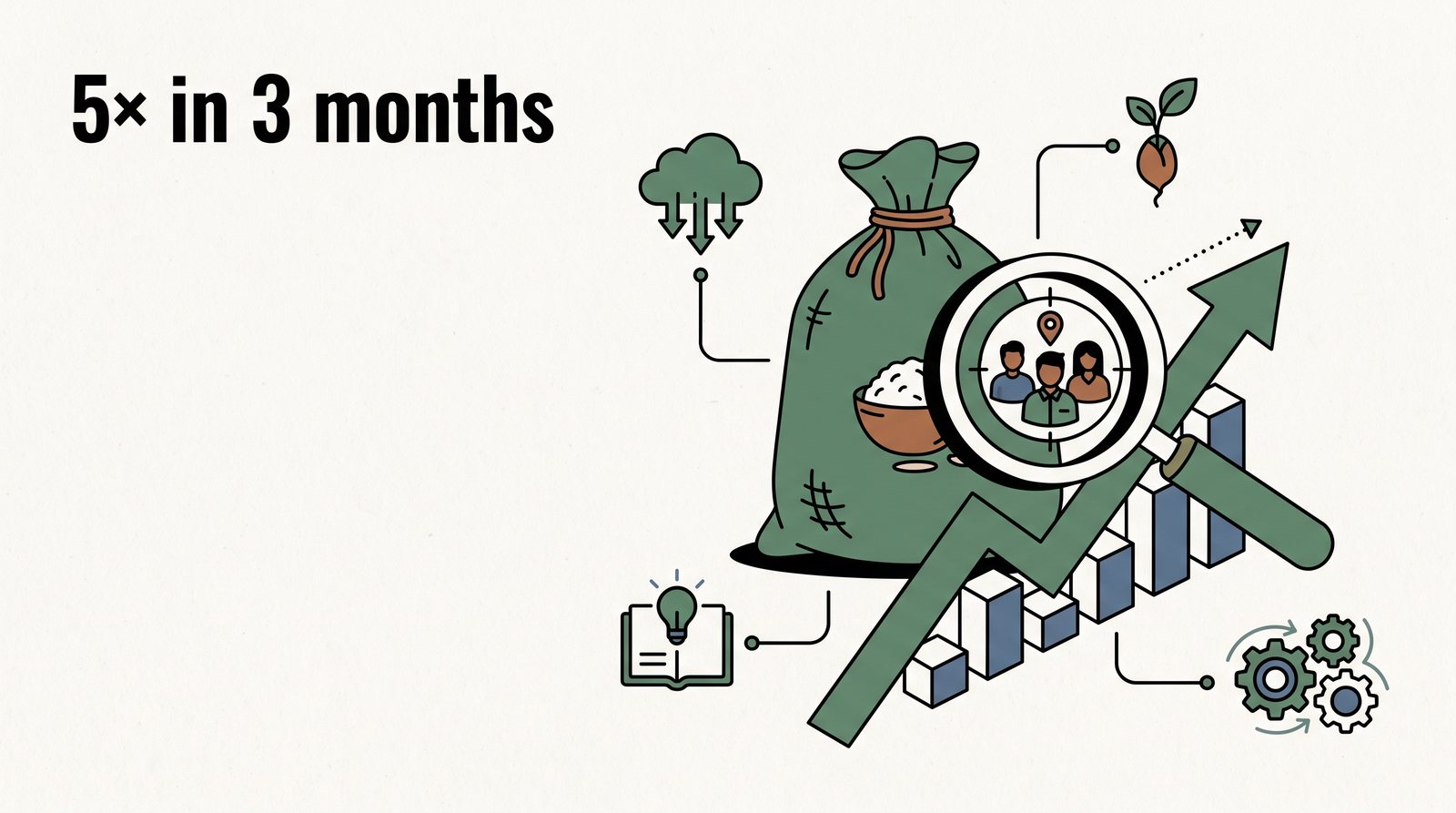
A low-GI rice brand was doing ₹50,000 a month online with a working website and a marketer already in place. Three months later it was doing ₹5 lakh a month. Nothing about the product changed. This is what did.
Engagement: D2C health food · Growth Marketing and Performance Marketing · partner since 2023
The numbers
- →Revenue: ₹50,000 a month to ₹5 lakh a month in three months
- →Core audience identified: men aged 25 to 45 in Hyderabad, 40 percent of revenue
- →Customer acquisition cost: ₹400 rising to ₹800 as we scaled
- →Lifetime value: ₹2,500 over six months
- →Expanded into Bangalore while holding the Hyderabad growth
The situation
The brand had everything a D2C food company is told to get: a store, a marketer, a product with a real health claim. What it lacked was a validated way to grow. Spending more on the existing campaigns was not a strategy; it was a hope. The founders needed to know who was actually buying and what a customer was worth before they could decide how hard to push.
What we did
Found the engine in the data. We ran structured tests across gender, age and geography. One segment stood out: men aged 25 to 45 in Hyderabad, who turned out to drive 40 percent of revenue. That became the core of every campaign.
Let CAC rise, on purpose. As we scaled into that audience, acquisition cost climbed from ₹400 to ₹800. The usual reaction is to pull back. Instead we measured lifetime value, ₹2,500 over six months, and made the deliberate call to keep acquiring, because a customer worth ₹2,500 is worth buying at ₹800. The maths, not the dashboard, made the decision.
Defended the position. When cheaper copycats launched on the same sourcing, we shifted part of the budget to brand and awareness campaigns so the original was the one people remembered, and opened Bangalore as a second market.
What made it work
The test-first structure. Most D2C accounts in India are built around whatever ran well last month. Testing across three dimensions at once found a segment the founders had not guessed, and finding it early meant every subsequent rupee went where the return was.
The second thing is the willingness to spend more per customer when the numbers say so. Cheap acquisition is only a virtue if the customers stay. Here they did.
What we would tell a founder in the same spot
- →Know your lifetime value before you judge your acquisition cost. One number without the other is meaningless.
- →Test audience segments before you test creatives. The wrong audience makes every creative look bad.
- →When copies appear, do not race them on price. Race them on being remembered.
- →Open a second city only after the first one is repeatable.
If you have a product that sells and a marketing budget that does not, the gap is usually targeting and measurement, not spend. Growth & Digital Marketing is the service behind this engagement, and the full results are on the work page.
FAQs
Which channels carried the growth?+
Meta, principally Instagram and Facebook, for acquisition, with search capturing the demand the campaigns created.
Did the site need work?+
Not for this phase. The store was fine; the targeting was the problem.
Is the brand still a client?+
Yes, since 2023, across scale-up, market defence and expansion.
Tags
About Author
Vidushi Kansal
Growth Marketing @ ShraviTech